How to tell which CV version is getting interviews
Most people rewrite their CV when a week feels quiet. Few people know whether the previous version was actually underperforming, or whether they simply hadn't applied enough, or applied to the wrong mix of roles.
Guessing burns time. A light feedback loop saves it.
You don't need fancy analytics. You need labelled versions, honest denominators, and enough patience that small samples don't turn into panic.
The problem with "this one feels better"
CV decisions often ride on gut feel:
- A friend preferred the shorter one
- You liked a new headline
- You changed everything after one rejection
- A template looked "more modern"
Feelings matter for confidence. They are poor substitutes for interview rate: interviews ÷ applications for that version (within a similar role family).
Raw totals mislead. Five interviews from twenty applications is different from five interviews from five. Without the denominator, "this CV is hot" is just a story you tell yourself on a good day.
Label every version before you send it
Start with boring hygiene:
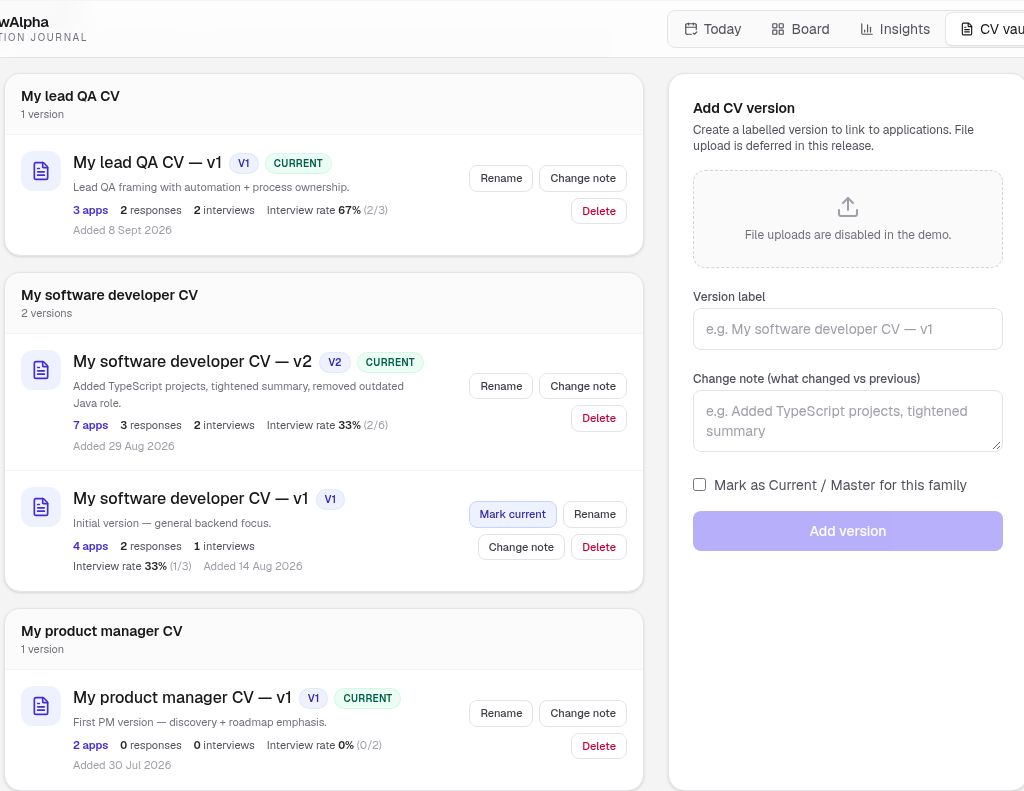
- Name versions clearly, e.g.
software developer CV - v2,product manager CV - v1 - Change the label when the content meaningfully changes (new summary, different emphasis, major reorder)
- Link the version to each application at the moment you apply
- Keep older versions so you can compare, not only overwrite
If you only keep the latest file on your desktop as CV_final_FINAL2.pdf, you will never learn anything useful.
A CV Vault (every labelled draft in one place, linked to the roles it went to) turns memory into a record. You always know which draft went where.
Measure what you can actually see
Useful fields per version (or per version × role family):
| Field | Why it helps |
|---|---|
| Applications | The denominator |
| Responses | Early signal (screening invites, recruiters reply) |
| Interviews | The outcome you care about most mid-search |
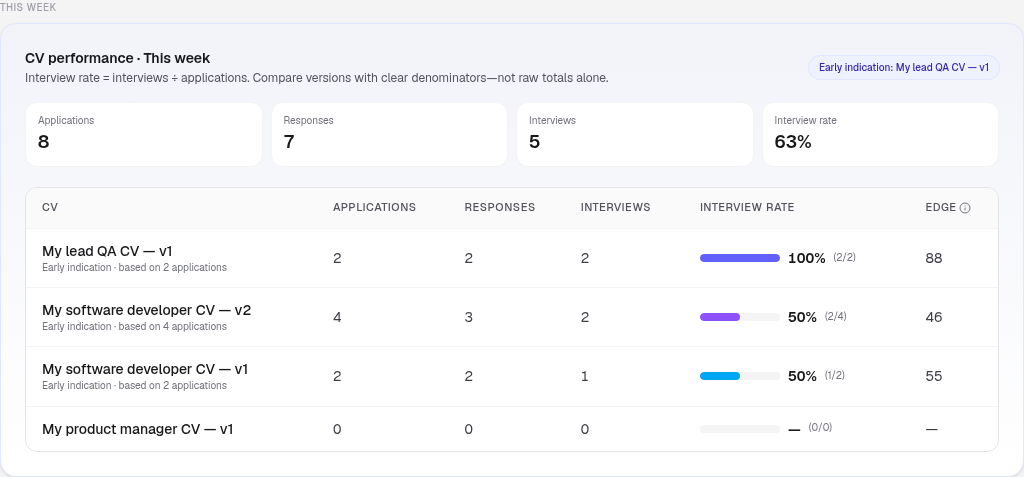
| Interview rate | Interviews ÷ applications |
Optional but helpful: source (referral vs cold apply) and role type, so you don't compare a referral-heavy week against cold LinkedIn blasts.
Responses are a softer signal than interviews. A polite "we'll keep your CV on file" is not the same as a hiring-manager conversation. Weight interviews more heavily when you decide what to keep.
Treat small samples gently
Three applications is not a verdict. Early numbers are indications, not gospel. Look for patterns after you have a modest sample in a similar lane, then adjust.
A calm product will label thin data as early indications rather than crowning a "winner" too soon. That tone matters; job search anxiety doesn't need fake certainty.
Rule of thumb: treat anything under roughly eight to ten applications in the same role family as provisional. You can still notice a lean, just don't torch version one because version two got lucky twice.
Separate version tests from role targeting
Two different questions get tangled:
- Is this CV better for this kind of role?
- Am I applying to roles that match my story?
If you send a senior PM CV to junior ops roles, the interview rate will look bad for reasons that aren't the formatting. Keep comparisons fair: same broad role family, similar seniority, similar apply channel when you can.
Change one meaningful thing between versions when you're deliberately testing (summary focus, skills order, project emphasis). Changing everything at once teaches you almost nothing.
A fair test looks like this
- Same role family (e.g. mid-level frontend roles)
- One primary change between v1 and v2
- Enough applications on each to compare without drama
- Notes on outliers (referrals, internal moves, unusual job ads)
Then ask: which version earns more interviews for this lane?
A simple weekly check
Once a week, ask:
- Which version has the clearest interview rate so far?
- Is the sample big enough to trust, or still early?
- Did my apply mix change (more stretch roles, more referrals)?
- What one change is worth testing next, and what will I keep stable?
You're not chasing a mythical perfect CV. You're reducing random rewrites and doubling down on what's earning conversations.
Where InterviewAlpha fits
InterviewAlpha's demo includes a CV Vault and Insights that compare applications, responses, interviews, and interview rate by CV version, so you see what's working, not only raw totals. Small samples are framed gently as early indications in the product copy. No account required to explore the interactive demo. A fuller product is coming; for now, the demo is the hands-on look at the feedback loop.
This is organisation plus a personal signal, not an AI resume factory, and not a tool that encourages spray-applying. The point is to learn from your pipeline: what you sent, what moved, what earned an interview.
Practical takeaway
- Label versions.
- Attach them to applications.
- Track interview rate with clear denominators.
- Respect small samples.
- Adjust one lever at a time.
- Review weekly so hunches don't overwrite the data.
When you can answer "which CV is earning interviews?" with a simple table instead of a guess, your search gets lighter, and your evenings get shorter.